AI agent marketing is rapidly becoming a core discipline as artificial intelligence moves from supporting buyers to actively representing them. The annual count of marketing technology tools came in at 15,505 this spring, up just 0.7% year over year. However, the headline number is misleading. Roughly 1,500 tools entered the landscape while roughly 1,300 disappeared. As a result, the category is no longer growing. Instead, it is churning.
The change is not gradual. According to the same research, 90.3% of marketing organizations now use AI agents in some capacity, but only 23.3% have reached full production deployments. Consequently, the gap between experimentation and production will determine the next three years of marketing-vendor consolidation.
The Shift From Human Buyers to AI-Assisted Buying Journeys
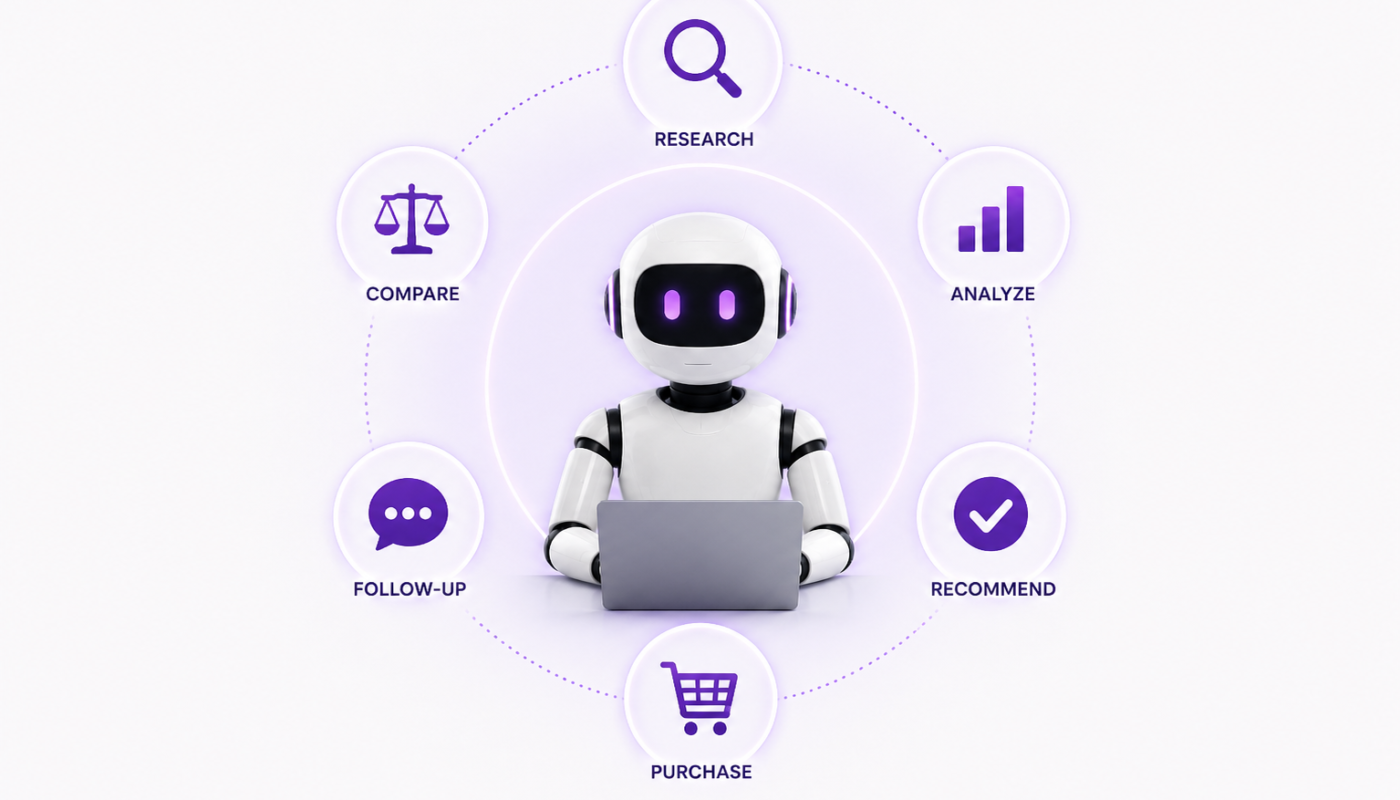
The more important shift is happening on the buyer side. Increasingly, an agent acting on a person’s behalf researches products, compares options, and even initiates purchases. Therefore, the implications for marketing operations are significant. AI agent marketing requires brands to optimize not only for human audiences but also for machine-driven evaluation systems.
For example, search optimization for human-readable answers is no longer sufficient. Likewise, catalog feeds that work for traditional comparison engines do not necessarily work for agents that parse structured data. Meanwhile, display and social ad creative built for human attention becomes less effective when the human is no longer directly involved in the buying journey.
Agent Visibility Is Becoming a New Marketing KPI
Three implications deserve serious attention. First, the new measurement target is agent visibility rather than brand visibility alone. Marketers need a clear answer to whether major consumer-side agents can find, evaluate, and recommend their products. Yet most organizations cannot answer that question today.
Moreover, measurement frameworks for AI agent marketing differ from traditional digital marketing metrics.
Second, content production economics are inverting. Generic content is now cheaper to produce and harder to distinguish. In contrast, content with provable authorship, trustworthy data, and clear domain expertise commands a premium because agents are more likely to surface it as authoritative.
How AI Agent Marketing Changes Content Economics
Organizations that invest in structured data assets are likely to gain an advantage as AI systems increasingly determine what information gets surfaced, summarized, and recommended. While organizations can now produce generic content at scale, trusted content remains scarce. Therefore, credibility is becoming a stronger competitive advantage.
Workforce Implications of AI-Driven Marketing Operations
Third, the workforce implications are real. Recent surveys show that 47% of B2B companies have reduced marketing headcount because of AI adoption, often through quiet attrition rather than layoffs. Nevertheless, the marketers who remain in their roles are doing more work and managing different systems than they were just two years ago.
The 74% of enterprises that deployed AI customer-facing agents and later rolled them back after governance failures damaged CX should serve as a warning rather than a discouragement. The technology is real. However, extracting value from it requires more discipline than the technology itself.
The marketers who succeed in this transition will not be the ones who buy the most agents. Instead, they will be the ones who learn to manage agents the way previous generations managed human teams: with clear objectives, continuous feedback loops, and accountability for output quality.
What Marketers Must Do Next
The marketing function in 2026 is genuinely different from what it was in 2024. Yet many marketers continue to operate as if little has changed. The organizations that master AI agent marketing early will gain a structural advantage as buying journeys evolve. Conversely, organizations that continue optimizing exclusively for human attention may discover that the audience making recommendations was never human in the first place.
Source: chiefmartec