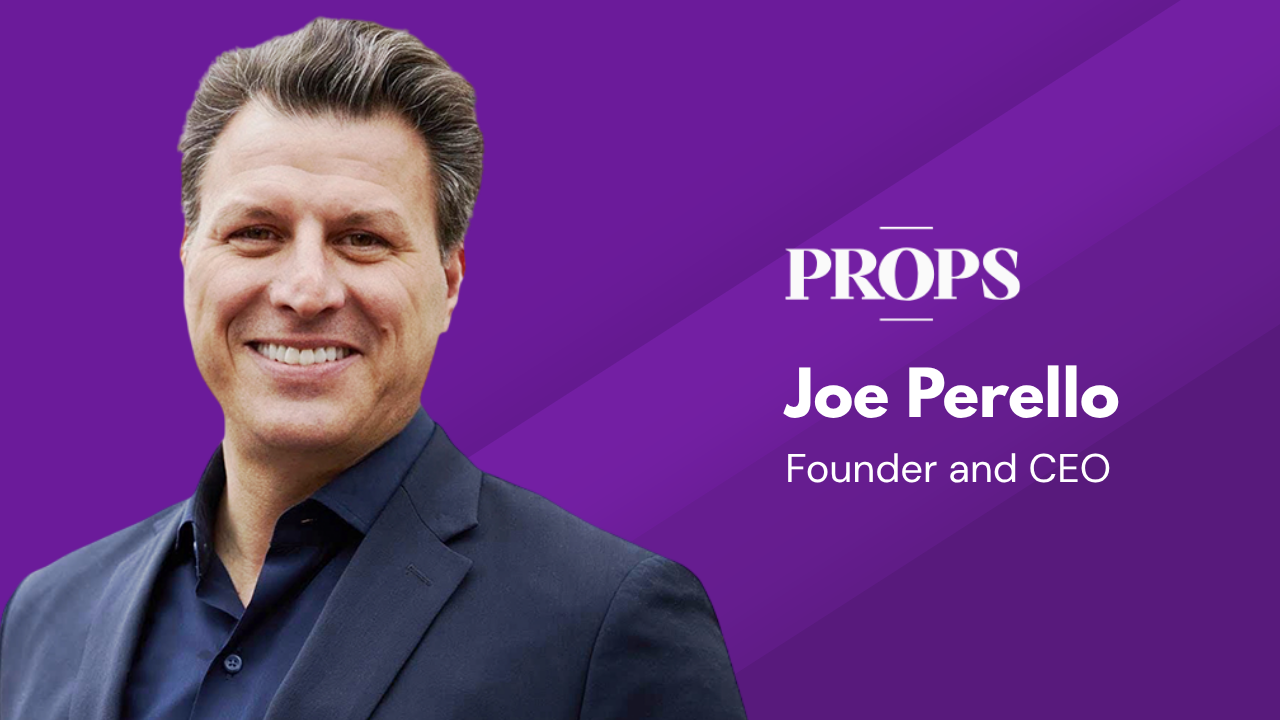
By Joe Perello, Founder & CEO, Props
Q1. What’s the vision behind Props and how has it shaped creator marketing?
The vision behind Props was to turn creator marketing into a reliable, scalable performance channel for brands.
When we started building Props seven years ago, creator marketing was largely measured through views, engagements, and likes – none of which could be tied to a business outcome. We believed those vanity metrics might work while the category was young, but it wouldn’t justify significant marketing budgets forever. Eventually, creator marketing would face the same standard as search, paid social, and every other major channel: prove that the investment drives business results.
We built Props for that moment, and today it is here. The Props idea was to preserve what makes creators uniquely valuable (the credibility of a real person) while adding the distribution, measurement, and optimization required of a serious media channel.
In order to make that vision a reality, we had to completely rethink the mechanics of creator engagements. We developed a new, full-funnel approach, and built tech to run it. Historically creator engagements were based on output (number of posts, assets delivered). Our relationships with brands were going to be based on outcomes. Every innovation we made was designed to lower our clients’ customer acquisition costs or deliver results a CFO could understand and model.
I wouldn’t claim Props caused the shift happening in creator marketing. We just anticipated it and built for it. Today, the industry is moving from creators as content to creators as a measurable media channel, and larger budgets are bringing greater scrutiny. The question coming from CFOs is, what business result did this investment produce.
That’s healthy for the category. Creator marketing shouldn’t get a pass on performance simply because it works differently from traditional advertising. We’ve spent seven years building the system to answer that accountability question while protecting the credibility that made creators valuable in the first place.
Creator marketing is becoming media and media has to perform.
Q2. Why have brands traditionally put so much weight on follower counts?
Follower count is visible, simple and easy to compare. For a long time, creator marketing borrowed its logic from traditional media. Bigger audience meant greater potential reach, so marketers naturally gravitated toward creators with the largest followings.
The problem is that follower count is an especially weak proxy for reach and influence on platforms such as Meta. The platform controls how many followers actually see an organic post, so a creator’s audience size doesn’t tell you how many people will receive the message. Marketers also often have limited visibility into how much of that audience matches the target, remains active, or will actually be reached.
So I think we’ve been asking the wrong question. Instead of “How many followers does this person have?” I want to know, “Why should somebody believe this person on this particular subject?” And then: “Can we efficiently put that person in front of the consumers we actually want to reach?”
If your objective is consumer action rather than exposure, those are much more useful questions.
Q3. What makes a smaller creator with real expertise more valuable than a large influencer?
A small creator isn’t automatically better, and a large creator isn’t automatically worse. That’s not the point. The point is that audience size tells you very little about whether someone is going to be persuasive on a particular subject.
Credibility follows personal consequence.
If someone has actually dealt with the problem, built expertise in the area or made the same kind of decision you’re asking the consumer to make, you can usually tell. They understand the questions people have. They understand the doubts. They know the trade-offs because they’ve lived them.
That comes through in the story.
Because Props doesn’t rely on follower count for reach, we can focus more on the fit between the person, the subject and the decision the consumer is trying to make. Our clients never need to choose somebody simply because a large number appears next to their name.
Q.4 How can brands tell when an audience genuinely trusts a creator?
I’d be careful about reducing trust to a single social metric. Likes, comments and follower counts tell you something about engagement, but not necessarily whether someone trusts a creator enough to change their behavior.
The stronger test is what people do after encountering the creator’s story. Do they click? Visit the brand’s site? Continue through the consideration journey? Ultimately, do they convert?
If a creator has genuine credibility with an audience, brands should be able to see it translate into stronger engagement, more efficient traffic and, eventually, better business results.
At Props, we can observe that behavior through performance measures such as clicks, CPC, conversion rates and acquisition costs, and then optimize campaigns in real time to deliver even greater outcomes.
A related question is how can brands work better with creators to create trust?
For brands to really leverage the inherent credibility of a creator and build trust, they can’t just have creators make ads touting products. The story matters. Ads ask for something from the audience; good stories give something to the audience. When a creator gives people genuinely useful information without asking for the sale, the audience values the interaction and trust deepens for both the creator and the brand. The creator then earns the right to guide them further through the purchase decision. Cramming awareness, consideration, and conversion into a single creator post that is essentially a brand ad is not going to build trust.
Q.5 Can creator marketing scale without losing its authenticity?
Yes, but I think you have to stop asking creators to provide the scale.
That’s one of the problems with the traditional influencer model. If the creator is also responsible for delivering the audience, you’re naturally going to gravitate toward people with bigger and bigger followings. And the person with the biggest following isn’t necessarily the person your customer is most likely to believe.
We think about those jobs separately.
The creator’s job is to bring knowledge, experience and a point of view that people find credible and relatable. Paid media’s job is to make sure the right people actually see it.
That separation lets us choose a creator because they’re right for the story, not because they happen to have millions of followers. We can preserve their voice and what makes them interesting in the first place, while using paid distribution through their social handles to reach the audience the brand actually wants.
That’s a much better way to scale than asking the creator to become something they’re not.
Q.6 Are marketers still measuring creator campaigns against the wrong metrics?
In many cases, yes. When we started Props in 2018, we started with performance in mind. I grew up professionally in the direct-response world, so measuring marketing by what people actually do, and what it costs to drive that action, has always been natural to me.
Creator marketing, however, largely grew up around a different set of metrics: followers, impressions, views, engagement and earned-media value. Those measures can describe exposure, but they don’t necessarily tell a CFO or CMO whether the investment created efficient growth.
From the beginning, we believed creator marketing should be held to the same standard as other acquisition channels.
That means asking the same questions marketers ask of search, paid social and other performance media: What did it cost to generate qualified traffic? What happened to conversion? What was the cost per lead, application or customer? And what happens to those economics as the program scales?
It also means being disciplined about measurement.
Props is very comfortable operating in a click-only world. In fact, we often default to it because it is the more conservative standard. But many of our clients measure performance using both click-through and view-through attribution, and we can work within either framework.
The important thing is comparability. We want Props evaluated on the same basis as the client’s other media channels so marketers can make meaningful performance and budget decisions. If a client uses click-and-view attribution across its media mix, we can use that framework. If they want click-only, we’re comfortable there too.
And attribution is only one layer of measurement. We routinely work within the broader systems our clients use to understand business impact.
For CPG brands, that can mean SPINS data to evaluate whether creator media is helping drive retail sales. For brand health, it can mean platforms such as Tracksuit to measure changes in awareness, consideration and brand perception. For enterprise media effectiveness, it can mean marketing mix modeling through firms such as Analytic Partners. And for incrementality, it can mean independent testing partners such as Trust Insights, alongside conversion lift and other experimental approaches.
The point is that Props doesn’t need its own special measurement system. We can be evaluated through the same measurement frameworks our clients use across their media mix, and we are comfortable being held to that standard.
Q.7 How can brands turn creator storytelling into measurable consumer action?
I think the starting point is recognizing that creators can make effective content for every stage of the customer journey. The mistake is expecting every piece of content to do every job.
At the traffic stage, for example, some of the most effective creator content may barely feel like advertising at all. It might be a useful lifestyle story about renovating a kitchen, planning a vacation or solving some other problem the consumer already cares about. The story can stand on its own because, in the Props model, it lives on the brand’s website. That means the creator can concentrate on telling a useful, credible story while the brand’s website does much of the selling around it. The consumer has entered the brand’s environment, where they can learn more, explore products and ultimately take action.
As the consumer moves further through the journey, the creator’s role can change. The content can become more explicitly connected to the product and, eventually, include a direct endorsement. At that point, the creator is lending their credibility to the brand and giving the consumer another reason to choose it.
So creator storytelling shouldn’t be thought of as one piece of content trying to accomplish everything. A creator can help generate interest at the top of the funnel, deepen consideration in the middle and endorse the product closer to conversion.
And because all of that can be distributed through paid media and measured against consumer actions, marketers can see whether the storytelling is actually moving people through the journey and ultimately contributing to business results.
Q8. What role does paid media play in scaling creator content effectively?
Paid media is the scale engine. Organic distribution asks, “Who already follows this creator?” Paid media asks, “Who should see this creator?”
For us, that’s the key distinction. It means we don’t have to choose a creator because they already own the audience we want. We can choose the person we think will be most credible on the subject and then use media to reach the consumers who matter.
At Props, that media runs through the creator’s handles. So you’re preserving the human source of the communication while adding the targeting and optimization you’d expect from a performance channel.
And then you can do the things good media teams already know how to do: sequence the message, retarget people, manage frequency, learn from performance and keep optimizing.
The creator doesn’t need to provide the scale. That’s what the media is for.
Q9. How should marketers connect creator influence to revenue and business outcomes?
Start with the goals that the business is actually trying to accomplish.
If the client needs applications, let’s talk about cost per application. If they need customers, let’s talk about customer acquisition cost. If they’re selling through retail, let’s look at what is happening at retail. I don’t think creator marketing should get a separate set of rules because creators happen to be involved.
And I wouldn’t stop at the first metric that looks good.
If a creator story produces a much higher click-through rate than a conventional ad, that’s interesting, but I’m not interested in celebrating the CTR on its own. I want to know what it does to the cost of traffic. Does that give us a larger, more efficient retargeting pool? Does conversion hold up? What happens to the cost of acquiring the customer?
That’s the chain that matters. We also look at what happens outside the Props channel itself. A person may encounter a credible creator story and later search for the brand, respond to another ad or convert through a different channel. We’ve seen evidence that creator media can improve the efficiency of those adjacent channels. We call that the Props Effect.
That’s why I like looking at the business from multiple angles. Daily attribution helps you operate the media. Longer-term measurement helps you understand what the media is doing to the business as a whole.
Q10. Is creator marketing becoming a performance channel rather than just an awareness tactic?
Marketers and CFOs are now demanding that creator marketing be accountable. But calling creator marketing a performance channel doesn’t make it one. You need to build campaigns from the ground up in a different way, and have a tech infrastructure that accelerates it. Even the legal agreements with the creators have to be different.
We started building toward this in 2018, and I think the broader industry is now moving in the same direction.
The traditional influencer model wasn’t really designed for this. Creator selection was heavily influenced by follower count. Distribution depended largely on the creator’s organic audience. Content often lived on social platforms rather than the brand’s domain. And measurement tended to focus on exposure and engagement.
If you change those things, the economics can change too.
Choose creators for credibility. Use paid media through their handles to provide scale. Give consumers substantive stories on the brand’s domain and continue the conversation with conversion-oriented creative. Then measure the whole system against the same business outcomes as the other channels competing for the client’s budget.
At that point, we’re not really talking about influencer marketing anymore.
We’re talking about using human credibility as the foundation of a measurable acquisition channel.
Joe Perello, Founder & CEO, Props
Joseph Perello is the founder and CEO of Props, the performance-based creator marketing platform. Props combines the humanity of creator content with the precision of paid media to deliver measurable business outcomes for brands.
In addition to leading Props, Joe serves on the board of directors of New York Cruise Lines, which oversees iconic brands such as Circle Line, New York Water Taxi, and World Yacht.
Prior to founding Props, Joe co-founded a digital agency in New York City, which he built from the ground up into an award-winning firm. His agency’s client list included top-tier brands such as Nike, Hewlett-Packard, Loews Hotels, Betterment, Cardtronics, and First Lady Michelle Obama.