Ronn Torossian is Founder & Chairman of 5W AI Communications. 5W is one of the largest private communications firms in the world.
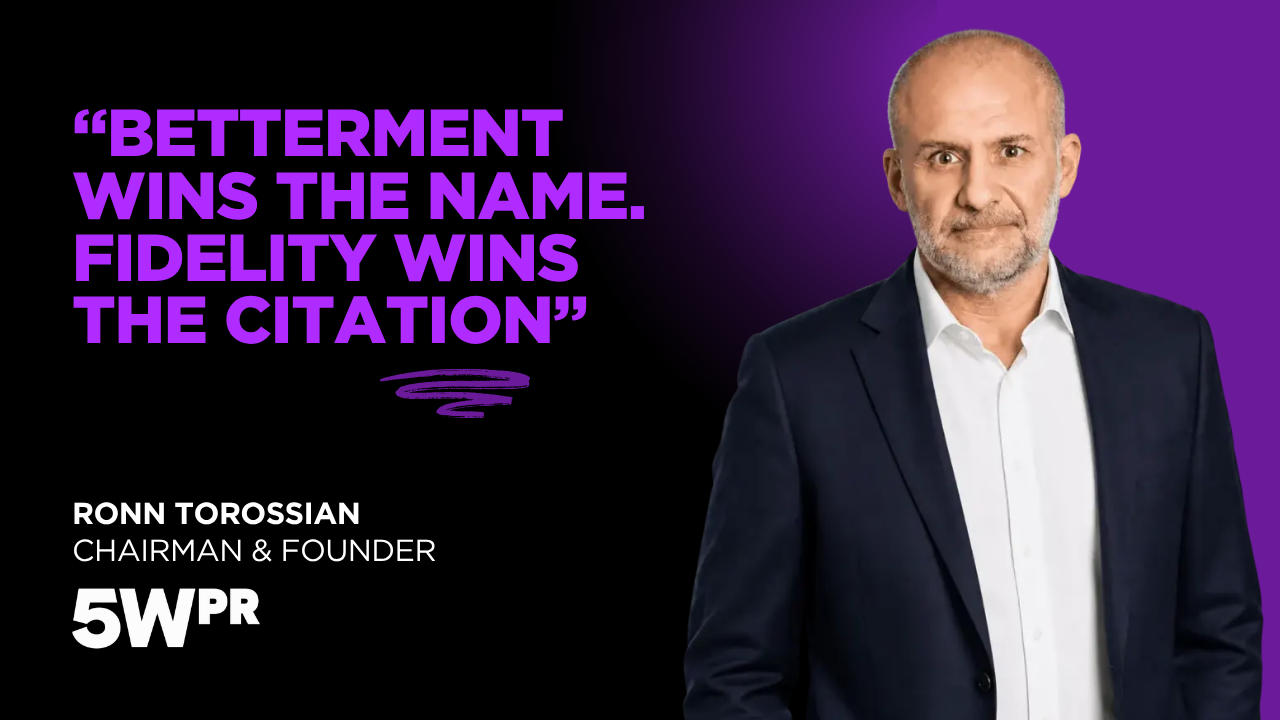
Ask an AI engine which robo-advisor to trust with retirement savings, and Betterment comes up more than any other name: 69.4% of the time, according to 5WPR’s Robo-Advisors & Retail Investing AI Visibility Index 2026, measured across 186 answers pulled from Perplexity, ChatGPT, Gemini and Claude. Ask which brand’s own website actually backs up that answer with a citation, and Fidelity wins, at more than double Betterment’s rate. In a category where trust is the entire product, those are two different contests, and most firms are only tracking one of them.
The Leaderboard Isn’t As Settled As It Looks
Betterment topped the appearance leaderboard, but Vanguard (66.7%) and Fidelity (66.1%) posted results close enough that their confidence intervals overlap Betterment’s. Statistically, this sample cannot say Betterment is more visible than either one. Wealthfront (62.4%) and SoFi (51.6%) round out a top tier that is more crowded than a single-number ranking suggests.
I’ve written before in this space about the danger of trusting a single-run AI visibility check. This study ran 24 prompts three times each, across four engines, 288 attempts, and still landed several of its top results inside overlapping margins of error. A marketing team that reports “we beat Vanguard this quarter” off data like this is reporting a coin flip as a trend line.
Naming Isn’t The Same As Sourcing
Here’s the finding that should reorder every fintech marketing budget in the category: Fidelity’s owned domain was cited in 26.3% of the 186 answers with retrieval evidence, the highest rate among the leading brands. Wealthfront followed at 17.7%, Vanguard at 14.0%, Charles Schwab at 13.4%, and Betterment, the appearance leader, at 12.4%. Robinhood, SigFig, Webull and Public each had a 0% owned-domain citation rate despite showing up in returned answers.
A 0% citation rate does not mean the brand is invisible. It means the brand is being discussed by the AI engine using someone else’s evidence, a publisher’s review, a comparison site, a Reddit thread, anything but the brand’s own product page. That is a company being talked about at the dinner table with no seat at the table.
The Four Engines Are Not Reading From The Same Script
Vanguard is a useful example of just how much the result depends on which engine you ask. ChatGPT named Vanguard in 97.8% of its 46 returned answers. Claude named it in 30.4% of its own 46. Same brand, same month, a 67-point spread. Fidelity showed the same pattern in reverse: Perplexity named it in 95.8% of answers, Gemini in 39.1%.
Publishers Still Own The Evidence Layer
Forbes was cited as a source in 72.6% of the 186 answers with retrieval evidence in this study, more than any brand’s own site. NerdWallet followed at 48.9%, CNBC at 35.5%. Fidelity.com, the strongest brand-owned domain in the data, still trailed Forbes by nearly 47 points.
That gap is the real story in regulated financial categories. Buyers asking an AI engine which robo-advisor to trust are, in practice, being handed a Forbes roundup or a NerdWallet comparison table, not a brand’s own explanation of its fees, its tax-loss harvesting mechanics, or its account minimums. The brand’s job is not to out-market the publisher. It’s to build the page that gives the engine a reason to quote the brand directly, in language the engine can lift without rewriting it.
What This Means Beyond Robo-Advisors
Robinhood, SigFig, Webull and Public now have a public data point showing their own sites are contributing nothing to the AI conversation happening about them. Charles Schwab has a 70-point engine gap it needs to understand before the next model refresh changes it again without warning. And every brand in this study, winners included, is competing against Forbes and NerdWallet for a citation slot that its own product pages are currently losing.
The firms that treat this as a one-time press release moment will be repeating this same exercise next year, wondering why the number moved. The firms that build direct, sourceable, regularly refreshed pages for the specific questions their buyers are asking, and check all four engines instead of one, are the ones that will still control their own story the next time someone asks a chatbot which robo-advisor to trust.